

Introduction In recent years, there has been a significant increase in the desire of Arab journalists to migrate to more stable and secure countries, due to the political, security, and economic challenges faced by many countries in the Middle East and North Africa. In this context, “Journalists Without Borders” conducted an extensive survey titled “Motivations for Journalists’ Migration” to understand the factors influencing journalists’ decisions to migrate and analyse the professional and social reasons driving them to seek opportunities abroad.
The survey targeted journalists from eight Arab countries: Iraq, Sudan, Egypt, Yemen, Syria, Lebanon, Tunisia, and Libya. These countries face diverse challenges that significantly impact press freedom and deplete journalists’ potential. Through this survey, we aim to highlight the state of journalism in these countries and examine the various factors contributing to journalists’ desire to migrate, whether related to professional issues such as low wages and professional restrictions, or social factors linked to the search for a better future in a more stable environment.
This report discusses the results of the survey, which involved 1,780 journalists from the aforementioned countries, and provides an analysis of the main reasons driving journalists to migrate, as well as the countries they prefer to migrate to and the key motivations that influence their decisions.
Basic Information about the Survey
The survey was created using Google Forms and consisted of 8 questions. The survey link was distributed to journalists between April 8, 2025, and April 30, 2025. It targeted journalists from eight Arab countries located in the Middle East and North Africa, namely Iraq, Sudan, Egypt, Yemen, Syria, Lebanon, Tunisia, and Libya, which are experiencing unstable political, security, and economic conditions. A total of 1,780 journalists participated in the survey.
Participation Rates by Country:
•
Iraq: 55.9%
•
Sudan: 25.9%
•
Tunisia: 8.8%
•
Egypt: 6.5%
•
Lebanon: 1.2%
•
Libya: 1.2%
•
Syria: 1%
•
Yemen: 0.2%
Participation Rates by Gender:
•
Male: 69.5%
•
Female: 30.5%
Participation Rates by Age Group:
Journalists without Borders
Journalisten ohne Grenzen
صحفيون بلا حدود
•
30-40 years: 43.7%
•
41-50 years: 25.9%
•
Under 30 years: 18.4%
•
Over 50 years: 12.1%
Response to the Question “Do you wish to migrate?”:
•
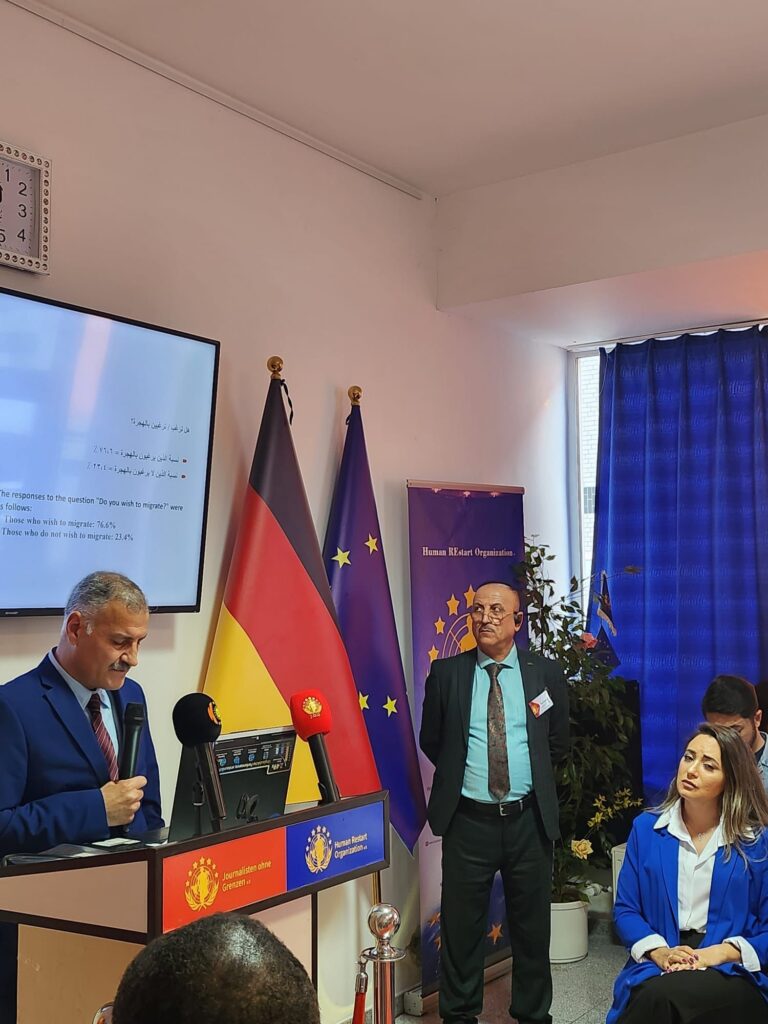
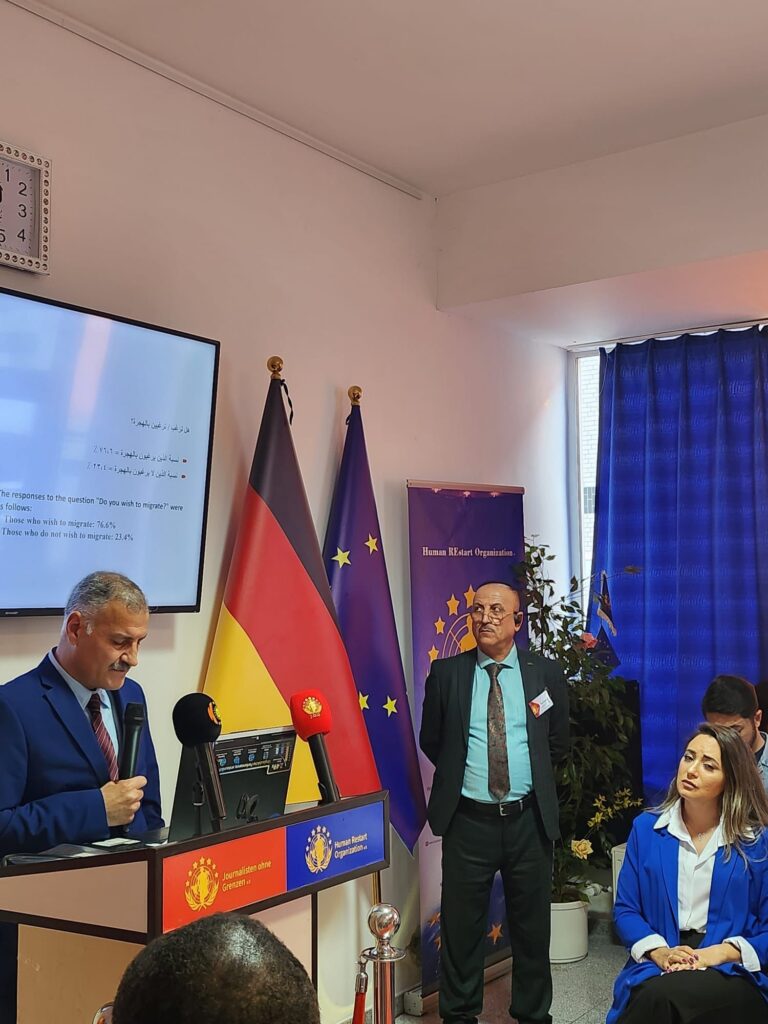
Yes: 76.6%
•
No: 23.4%
Professional Motivations for Migration: Journalists indicated that low wages, professional restrictions, and the scarcity of independent institutions are among the key professional motivations driving them to migrate.
Social Motivations for Migration: Poor economic conditions and the search for a better life were prominent social motivations that led journalists to consider migration.
Other Factors Influencing the Decision to Migrate:
•
Lack of respect for the profession by some circles
•
Unsafe journalistic environment threatening the lives of independent journalists
•
Direct threats from the government or armed militias
•
Absence of institutions to elevate the media profession
•
Lawsuits filed against journalists by politicians and officials
Countries Preferred by Journalists for Migration:
•
Canada
•
Switzerland
•
United Kingdom
•
United States of America
•
Australia
•
Germany
•
Sweden
•
France
•
Italy
•
Russia
•
Oman
•
United Arab Emirates
•
Qatar
•
Saudi Arabia
Analysis of the Results of the “Motivations for Journalists’ Migration” Survey
1.
Participation by Country:
The results of the survey indicate that Iraq had the highest participation rate (55.9%), reflecting the challenging conditions journalists face in this country, including security and political threats that may push them to seek better opportunities abroad. Sudan followed with 25.9%, indicating that there is also an unstable situation
Journalists without Borders
Journalisten ohne Grenzen
صحفيون بلا حدود
in this country affecting journalists. On the other hand, countries like Yemen and Syria had very low participation rates (0.2% and 1%, respectively), which may reflect the difficulties in reaching journalists in these countries due to security issues and logistical challenges.
2.
Participation by Gender:
The results show that males accounted for 69.5% of the participants, while females represented only 30.5%. These figures suggest that journalism in Arab countries might be more closely associated with men, both in terms of available opportunities and actual participation in the survey. This could also reflect the challenges faced by female journalists in some countries, whether in terms of societal acceptance or the work environment.
3.
Participation by Age Group:
The survey reveals that the most active age group was 30-40 years, which constituted 43.7% of the participants. This indicates that journalists in this age group are the most concerned about their professional status in the current environment and are likely seeking new opportunities in more stable environments. The next most represented group was 41-50 years with 25.9%, which suggests that journalists in this age range may be at the peak of their careers and facing significant professional and economic challenges pushing them to migrate. The under 30 yearsgroup represented 18.4%, indicating that younger journalists may not face the same pressures as older ones but might still be seeking better professional futures. Those over 50 years accounted for 12.1%, suggesting that older journalists are less affected by the desire to migrate compared to younger age groups.
4.
Desire to Migrate:
A notable 76.6% of the participating journalists expressed a desire to migrate, which is a very high percentage. This indicates that the professional and social conditions in the Arab countries included in the survey have prompted journalists to consider migration as a solution to their challenges. In contrast, 23.4% of the participants did not wish to migrate, which may either reflect their relative satisfaction with the current situation or the inability to migrate due to financial or legal barriers.
5.
Professional Motivations for Migration:
The key professional motivations for migration highlighted by the participants were low wages, professional restrictions, and the scarcity of independent institutions. These factors reflect the difficult conditions journalists face in these countries, both professionally and economically. Professional restrictions are a major obstacle to journalistic freedom, especially in media environments under political or security pressure. The scarcity of independent institutions indicates that journalists may lack platforms to work freely, which drives them to seek opportunities in other countries.
6.
Social Motivations for Migration:
Journalists without Borders
Journalisten ohne Grenzen
صحفيون بلا حدود
Regarding social motivations, the poor economic situation, the search for a better future, and security threats were among the most prominent factors driving journalists to consider migration. This suggests that economic hardship and an unclear future are the largest factors influencing journalists’ decisions to migrate. Additionally, security threats from governments or armed groups make journalism unsafe in some of these countries, prompting journalists to seek safety in more stable countries.
7.
Preferred Countries for Migration:
Journalists expressed varied preferences regarding the countries they wish to migrate to. Canada topped the list of preferred destinations, followed by the United Kingdom and the United States of America. These countries have a strong reputation for protecting journalists and providing a stable and safe environment for journalistic work. Germany and France were also among the favored destinations, reflecting journalists’ desire to migrate to European Union countries that offer a high level of professional security and press freedoms.
Recommendations:
•
Improving Journalistic Working Conditions: Efforts should be made to support independent media institutions and provide educational and training opportunities for journalists across Arab countries.
•
Enhancing Journalists’ Rights and Protection: There is a need to strengthen journalists’ rights and protect them from political and economic threats that could lead to the deterioration of their professional conditions.
•
Opening Additional Support Channels: Additional support mechanisms should be created to help journalists adapt to the economic and professional challenges they face in their working environments.
Supervisors of the Survey:
•
Dr. Habeeb Ibrahim (Head of Public Relations, Research, and Surveys Department – Journalists without Borders
•
Abdulhamid Zibari (Iraq)
•
Abdullah Muhammad (Egypt)
•
Afrah Al-Faisal (Iraq)
•
Ahmed Khalil (Sudan)
•
Ahmed Shehab (Iraq)
•
Bandawar Muhammad (Germany)
•
Emad Al-Din Al-Najjar (United States)
•
Fatima Lawati (Tunisia)
•
Hemen Kakayi (Iraq)
•
Laveen Sirwan (Iraq)
•
Maeen Saleh (Yemen)
•
Mohsen Al-Yazidi (Morocco)
•
Rawchi Hassan (Germany)
•
Sarah Matar (Lebanon)
•
Yasser Al-Shammari (Iraq)
•
Zainab Al-Sindi (Iraq)
Journalists without Borders
Journalisten ohne Grenzen
صحفيون بلا حدود